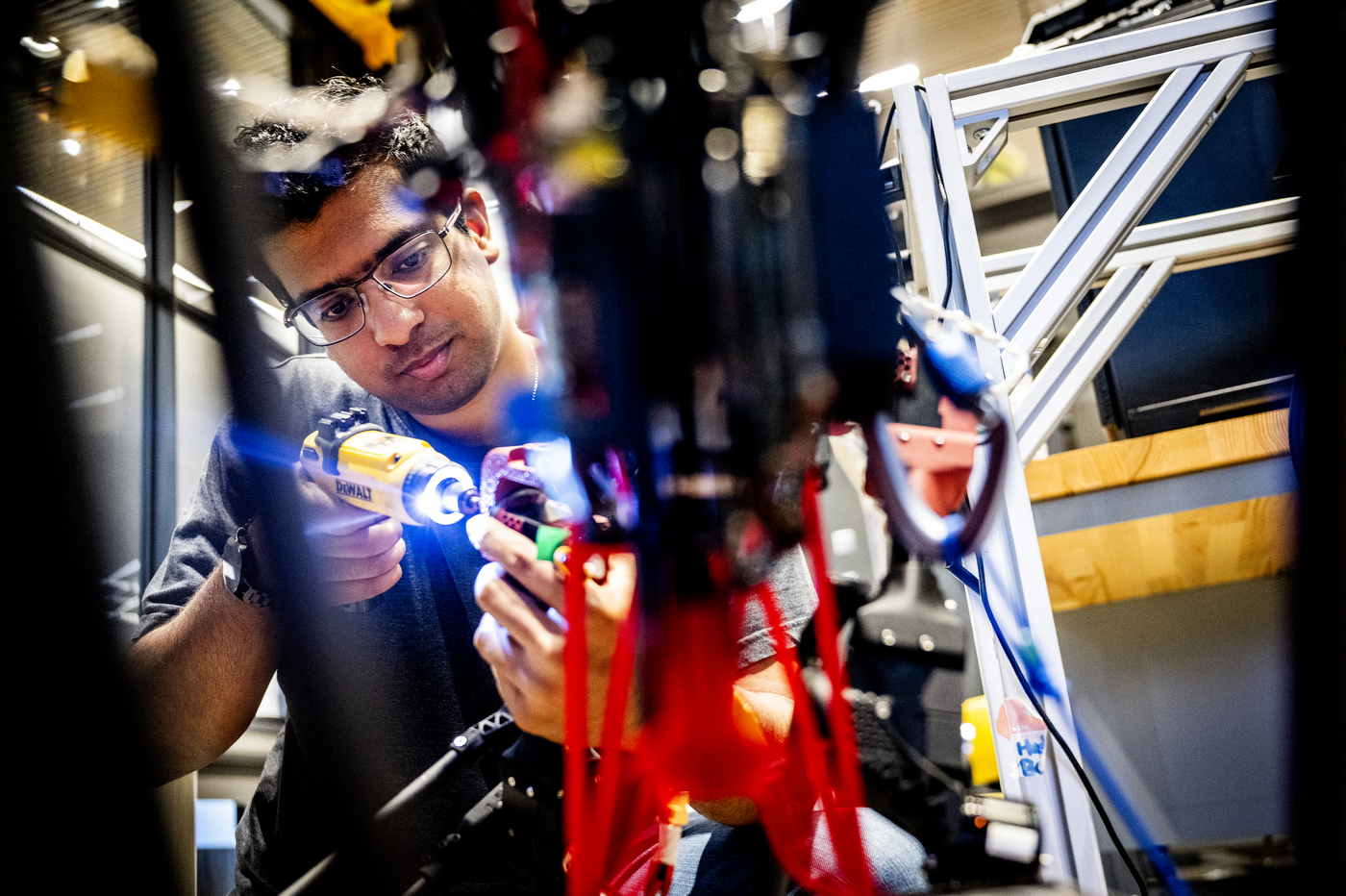
MS. Robotics, BE. Electrical and Electronics Engg.
Past affiliations
Woods Hole Oceanographic Institute (WHOI), Indian Institute of Science (IISc)
Working on
Trajectory optimization, Model Predictive Control, Morphing robots, Multi-modal locomotion
Robots
COBRA
2022 - Now · SiliconSynapse Lab, Northeastern University
COBRA is a 2m long snake robot that operates untethered, with a stereocamera and processor in the head for localization, mapping and control. It was initially developed as a proof of concept for the NASA BIG Idea Competition in 2022, which called for energy-efficient alternate mobility solutions for craters on the lunar south pole. The original team was 13 undergraduate students from various backgrounds, with me as the sole graduate student in an advisory capacity; together we showed basic manual control with simple gaits. After winning the competition, COBRA became the focus of my PhD work, where I led the research to expand the gait library, integrate perception, and run SLAM onboard. I also developed a contact-implicit model predicting the robot's motion under various gaits, and demonstrated autonomous behaviors such as path tracking and loco-manipulation.
2023 - Now · Caltech and SiliconSynapse Lab, Northeastern University
M4 is a wheeled robot that can morph into a UAV to fly. Designed at Caltech by my PhD advisor with a post-doctoral student, the first version showed the transforming behavior and various locomotion modes, combining thrusters and wheels to traverse a wide variety of terrain. I became involved with later versions, writing control firmware and contributing to experimental demonstration of its capabilities. I guided a few MS students through thesis research into traversability estimation for multi-modal path planning, to autonomously decide when to drive or fly. I also explored morphing in flight for fault-tolerant, agile flight, and led the development of a new 3D-printed lightweight version at Northeastern, later used with a humanoid robot in a multi-robot collaboration demo at Caltech.
2021 - Now · SiliconSynapse Lab, Northeastern University
Aerobat is a small 30g bat-robot with a payload capacity of just 15g for all sensing and compute. Flapping-wing robots suit confined spaces where collisions with the walls are likely, contact-rich locomotion like wheels or legs is not possible, and rotary-wing platforms struggle with turbulence from their own wake. Open questions remain on their control, and on state estimation for autonomous operation. I first worked on Aerobat for my MS thesis, integrating a lightweight sensing and compute package for visual-inertial odometry. Since moving to COBRA for my PhD, I have continued collaborating with the team, building dynamic models and state estimation.
2021 - Now · SiliconSynapse Lab, Northeastern University
Husky is a lightweight quadruped with propellers on its back for aerial and thruster-assisted ground locomotion. This extends its range beyond standard quadrupeds — walking on narrow paths, steep slopes, and low-friction surfaces, or flying over terrain that is inaccessible or unsuitable for legs. Through my PhD I have collaborated on this platform, building firmware, models, and experimental demonstrations of the multi-modal operation.
2021-2023 · Woods Hole Oceanographic Institute (WHOI)
During my Master's, I did a co-op at the Woods Hole Oceanographic Institute (WHOI), where I worked with Amy Kukulya on REMUS and LRAUV robots. The LRAUV is built for long-range missions of around 2000 km, controlled remotely over a cellular network. I was involved with field operations and software support as we collected ocean data off the coast of Cape Cod, Massachusetts. One test in particular pushed the remote-operation limits: deployed from a boat near the coast, the robot drove two days to reach the continental shelf, spent a week collecting salinity data under remote monitoring, and drove all the way back for recovery — 11 days in all, with every operator staying on shore. The stakes were far higher than lab work: the robot was inaccessible for most of the mission, any issue had to be handled remotely, and many layers of failsafes and systems kept the missions running without a hitch. That experience has shaped how I have worked since.
Autonomy is a spectrum from full manual control at the actuator level on one end, to minimal natural language instruction at the other end. But robots only need to be as autonomous as the task demands. I work on low-level autonomy: I build controllers that produce actuator commands to keep a robot stable and drive it in a target direction.
I have worked on a range of robots that move in unique ways, from conventional multi-rotor UAVs, legged and wheeled robots to the less conventional snake robots and bat robots, and the task of autonomous control has been slightly different on each. I build these controllers using trajectory optimization and model predictive control.
Thruster-assisted incline walking on Husky
On the Husky Carbon quadruped I built a controller for thruster-assisted walking on steep inclines. Husky has electric ducted fans that can be vectored to supplement the ground reaction forces from its legs. I reduced the robot to a low-order model, approximated its dynamics with polynomials, and used a collocation method to solve for the joint and thruster commands that walk it up slopes of up to 45 degrees without violating the friction cone at the feet.
M4 in flight mode
I led the controls for the morphing M4 robot, which turns its legs into rotor arms to fly. I built a nonlinear model predictive controller that solves posture manipulation and thrust vectoring as a single problem. I derived a high-fidelity and a reduced-order flight model that capture how M4 shifts its mass by repositioning its limbs, and used NMPC to demonstrate recovery from a rotor failure in flight. I have also used the same controller for agile flight maneuvers.
COBRA slithering
On the snake robot COBRA, most locomotion is contact-rich and over-actuated. For slithering gaits I built a reduced-order model based on Moreau’s stepping-forward scheme from differential inclusion mathematics, which handles the making and breaking of ground contact without enumerating contact modes, and solved for trajectories using contact-implicit optimization. I extended the same approach to loco-manipulation, where COBRA moves objects through locomotion. For real-time steering during slithering I also use a feedforward scheme that commands a differential amplitude between the front and rear of the body’s undulation to turn the robot toward a target heading.
COBRA can also link its head to its tail to form a ring and tumble down slopes. Tumbling is passive and energy efficient but gives up control authority. I showed that COBRA can steer while tumbling by dynamically manipulating its posture to shift its mass distribution, modulating forward velocity and heading angle. I derived the dynamics of posture manipulation during tumbling, built a closed-loop heading controller, and validated it in hardware for obstacle avoidance using posture alone.
Aerobat flapping flight
The bat-inspired Aerobat is too light to carry the sensing and compute needed to stabilize itself, so it flies inside a multi-rotor guard. The guard cannot directly observe the flapping robot’s state. I worked on an observer that estimates those states and closes the loop for stable hovering of the combined system. I also worked on conventional multi-rotors, including a high-speed local planner that generates trajectories that stay within the quadrotor’s dynamic limits so it can fly aggressive paths without having to slow down.
Higher up the spectrum, the controller has to decide where to go rather than be told. I built a vision-guided loco-manipulation pipeline for COBRA that runs a YOLOv8 detector on an onboard stereo camera, fuses it with depth to estimate the six-DOF pose of a target object, and closes the loop so the robot can locate an object, move to it, and bring it to a goal. On M4, which can drive, fly, segway, or crawl, the choice of mode depends on the terrain. I contributed to a self-supervised method that estimates the cost of transport of the surroundings from vision and runs on onboard compute, so the planner can choose the cheapest mode for the terrain ahead, and earlier to demonstrating autonomous 3D path planning across the robot’s ground and aerial modes using SLAM and off-the-shelf planning.
Custom carbon-fiber drone, IISc
Before my PhD, at the Indian Institute of Science, I worked on landing a UAV on a moving platform using a monocular camera and fiducial markers to localize the drone and PID control to track and land on the target. I wrote a companion paper on the practical challenges of doing this outdoors, where wind, lighting, and heavier airframes complicate the indoor solutions. The same drone was intended to carry sensing and compute for autonomous obstacle avoidance.
build
I build robots from scratch... mostly
I have an electrical engineering degree and I write software. Between those two, I am qualified to handle most parts of building a robot. I also often offer my unqualified opinion on mechanical design and fabrication based on my experience, which has been a valuable contribution to the projects I have worked on.
Husky Carbon quadruped robot with thrusters
I am doing my PhD with the SiliconSynapse Lab, where I lead the development of several unique robots. We build custom robots that operate using unconventional modalities such as combining aerial and wheeled locomotion into one morphing robot, and a bio-inspired snake robot among others. These pose singular challenges in terms of both hardware trade-offs between weight, performance and size, as well as software architecture design challenges to safely and reliably handle the unique locomotion modes of these robots.
COBRA snake robot
I built the software and controls for the snake robot COBRA. The project started as an entry to the NASA BIG Idea Challenge 2022 for alternate mobility on the moon, and upon winning the challenge, was expanded into several research tracks that I led through my PhD.
I also led the design of a new version of the multi-modal robot M4 that combines wheeled ground and aerial locomotion in one morphing structure. The new version is 3D printed and at 2/3rd the scale of the original M4 built at Caltech by my advisor. Scaling such a platform is a unique challenge due to the tension between the flight mode, which needs a low weight, and the actuators required for morphing and driving in ground mode.
M4 morphing ground-aerial robot
I led the development of the new version, and wrote the software architecture and control interface used by several variants of M4 both at Northeastern University and Caltech. This work enabled a marquee demonstration in collaboration with Caltech, where our M4 robot was used in a multi-robot operation in conjunction with a humanoid.
Before my PhD, I also worked for a year building various drones at the Indian Institute of Science.
Custom carbon-fiber drone, IISc
One notable project there was a custom drone built from carbon-fiber-wrapped balsa wood that we laser cut and wrapped ourselves in a bid to increase the payload capacity and available space on a stock S500 drone to support payload delivery with sensors and compute for autonomous obstacle avoidance. The stock S500 frame weighed 0.85 kg and our redesigned frame came out at 0.35 kg. Covid cut that work short, but not before a successful piloted flight that turned out to be surprisingly stable compared with the original due to lower vibrations and larger rotor spans.
unstructured
I send robots where humans cannot go
The reason these robots take unusual forms is the places I want to send them: environments that are hard or impossible for people to reach, where conventional robots also struggle.
The bat robot is built for confined tunnels not much larger than itself, like sewer and HVAC ducts, for inspection and monitoring. The snake robot is built for rough, rocky terrain: it started as an entry to NASA’s BIG Idea Challenge for reaching permanently shadowed regions in lunar craters like Shackleton, and it also navigates large-scale, cluttered environments such as caves. M4 targets mixed terrain where the cheapest way across changes from one stretch to the next, switching between driving and flying. Husky is for terrain at the edge of what legged robots can manage, like steep slopes and narrow paths. The underwater vehicles operate in the deep sea, one of the least accessible environments there is. And at the Indian Institute of Science I flew drones over lakes for surveying and mapping.
operate
I operate robots in the field
Building a robot and operating one in the field are different problems, and a lot of what makes field operation hard does not show up in the lab.
When something breaks in the field, I have to fix it with whatever I brought. There is no bench, no full parts bin, and only a limited set of tools, so either the robot is repairable in those conditions or the day is over. Underwater this is at its most extreme: a vehicle operating kilometers away is out of reach for the length of a deployment, and even when recovery is possible, depressurizing, opening the hull, doing the repair, resealing, and redeploying can take a full and expensive day.
Safety is a constant constraint. These robots run spinning rotors and thrusters and operate around water and around people, and a failure in the field carries consequences a simulation does not.
I have run field operations at the Indian Institute of Science, flying drones to survey and map lakes, and at the Woods Hole Oceanographic Institution, operating autonomous underwater vehicles where the cost of a mistake is a lost robot.
robots
I make all kinds of robots
The robot fits the task, not the task the robot. I have worked on a range of conventional and unconventional robots.
I worked on a bat-inspired morphing-wing robot with a 30 cm wingspan and a total weight of 45 g, meant to fly through confined tunnels about its own size, around half a meter across, such as sewer or HVAC tunnels for inspection and monitoring. It had a 15 g payload budget for sensing and compute, and its morphing wings made the dynamics hard to model.
I worked on M4, which combines wheels and flight. In flight it uses its appendages to position its thrusters for agile behaviors; on the ground it uses them to change its wheelbase for traversal. It decides on its own when to drive or fly.
I worked on underwater vehicles at my co-op at the Woods Hole Oceanographic Institution. It gave me insights into designing for reliable operation when the robot is inaccessible, and into things you do not usually think about, like corrosive seawater and low-bandwidth acoustic communication.