Hello, I'm...
Adarsh Salagame
Trajectory optimization and model predictive control for morphing and multimodal robots.
I have built and worked on a wide variety of conventional and unconventional robots from legged systems, underwater robots and drones, to snake robots, flapping wing systems and morphing multi-modal robots.




Background
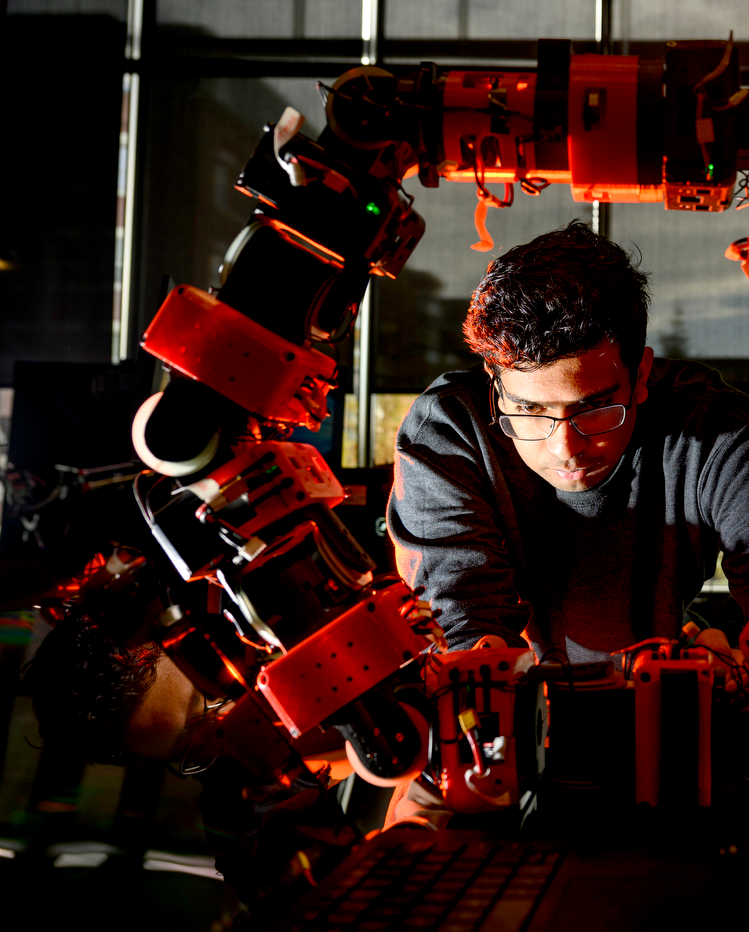
I am a PhD student at the University of Illinois, Urbana-Champaign, advised by Alireza Ramezani at the SiliconSynapse Lab. I began the PhD at Northeastern University and moved with the lab to Illinois in 2026. My thesis work centers on trajectory optimization and MPC for a snake robot, exploring ways to exploit the redundant articulation and contact-rich environment interaction to traverse diverse terrain and perform tasks such as loco-manipulation. I am also working on multi-modal locomotion on ground-aerial platforms with variable morphologies, using posture manipulation in flight to reposition thrusters with respect to the center of mass for agile maneuvers and fault tolerance. Before my PhD, I spent a year at the Woods Hole Oceanographic Institution working on long-range autonomous underwater vehicles, and a year at the Indian Institute of Science developing autonomous flight for UAVs. I received my B.E. in Electrical Engineering from BITS Pilani, Hyderabad in 2019 and my M.S. in Robotics from Northeastern in 2022.
Recent Updates
-
IROS 2026 in Pittsburgh, USA
Autonomous Whole-body Loco-manipulation Using a Snake Robot.
The paper develops a sidewinding locomotion controller for a snake robot, demonstrating autonomous loco-manipulation to plan, approach and push a box to a goal location. We show experimental results using motion capture for feedback demonstrating path planning in real time and successful delivery of the box to the target position.
-
Transfer to the University of Illinois
The SiliconSynapse Lab, and my Ph.D. advisor Prof. Alireza Ramezani, has moved from Northeastern University, Boston to the University of Illinois, Urbana-Champaign starting Fall 2026. I moved with him and all the robots to complete my Ph.D.
-
Robotics and Autonomous Systems Journal
Contact-Implicit Modeling of Snake Robot Sidewinding on Compliant and Granular Terrain.
DOI: https://doi.org/10.1016/j.robot.2026.105705
The paper proposes an extension of Moreau’s stepping method for contact modeling with the inclusion of a spring-damper contact force law combined with soil properties derived from soil contact models to model movement on granular surfaces such as sand. Through experiments and simulation, it shows that the spring-damper contact model can predict the motion of the robot on sand with reasonable accuracy, with the aim of using this model in a receding horizon gait controller.
-
Advanced Intelligent Systems Journal
Crater Observing Bio-Inspired Rolling Articulator (COBRA)
DOI: https://doi.org/10.1002/aisy.202500352
The paper presents the key motivation for the devlopment of the snake robot COBRA, and details its design, operating principle, capabilities and control framework.
-
IROS 2025 in Hangzhou, China
Presented two papers relating to snake robot autonomous operation: